 Add to Chrome
 Add to Firefox
 Add to Edge
Dual-Channel Tensor Neural Networks: Finite-Sample Theory and Conformal Structure Selection
May 18, 2026
Tensor-valued data arise naturally in neuroimaging, genomics, climate science, and spatiotemporal networks, where multilinear dependencies across modes carry information that is destroyed under vectorization. Existing approaches either impose a single low-rank structure, which can miss localized signal, or treat the tensor as a long vector, which discards its multiway geometry. We propose a *Dual-Channel Tensor Neural Network* (DC-TNN) that decomposes each tensor input into a low-rank core and a sparse refinement, and processes the two components through coupled neural channels. The framework is structure-agnostic and accommodates CP, Tucker, and tensor-train cores within a single architecture. For estimation, we establish non-asymptotic risk bounds for the DC-TNN estimator that decompose into network approximation, core estimation, and refinement-selection terms, and show that the effective dimension is determined jointly by the core rank and refinement sparsity rather than by the ambient tensor size. For inference, we develop a *structure-aware conformal ROC* procedure that calibrates within the core-refinement latent space and produces ROC and AUC confidence bands with finite-sample, distribution-free coverage. Building on this, we propose a *conformal structure selector* that, to our knowledge, is the *first distribution-free procedure* for choosing among candidate tensor decompositions with finite-sample validity. Simulations and an analysis of a protein dataset demonstrate competitive predictive accuracy, reliable uncertainty quantification, and consistent recovery of the tensor structure.

Learning to Hand Off: Provably Convergent Workflow Learning under Interface Constraints
May 18, 2026We study workflow learning in a setting where specialized agents hand off control through a shared artifact, each agent observes only a local function of that artifact and its own private state, and no centralized learner accesses joint trajectories -- the operating regime of multi-agent LLM pipelines that span organizational, vendor, or trust boundaries. We formalize this regime as an interface-constrained semi-Markov decision process (IC-SMDP), whose decision epochs occur at handoff times, and design IC-$Q$, an asynchronous decentralized $Q$-learning algorithm in which cross-agent coordination at every handoff is exactly one scalar. Our main result is a finite-sample bound for neural IC-$Q$ that decomposes into three independently controllable error sources: neural function-approximation error, interface representation gap, and a mixing-time residual, under the random option-duration discount. Establishing this bound requires lifting the approximate information state (AIS) framework from single-agent primitive-step MDPs to multi-agent SMDPs and controlling Markovian noise under random duration, neither of which has been done in prior work. To our knowledge this is the first finite-sample guarantee for neural $Q$-learning under decentralized partial observability. Four experiments: a controlled synthetic IC-SMDP that validates the bound term-by-term, multi-LLM mathematical reasoning, multi-agent routing, and multi-agent CPU programming, show that IC-$Q$ matches a centralized oracle without any agent observing joint trajectories, with each of the three error sources scaling along its corresponding axis as the bound predicts.
CiteVQA: Benchmarking Evidence Attribution for Trustworthy Document Intelligence
May 13, 2026Multimodal Large Language Models (MLLMs) have significantly advanced document understanding, yet current Doc-VQA evaluations score only the final answer and leave the supporting evidence unchecked. This answer-only approach masks a critical failure mode: a model can land on the correct answer while grounding it in the wrong passage -- a critical risk in high-stakes domains like law, finance, and medicine, where every conclusion must be traceable to a specific source region. To address this, we introduce CiteVQA, a benchmark that requires models to return element-level bounding-box citations alongside each answer, evaluating both jointly. CiteVQA comprises 1,897 questions across 711 PDFs spanning seven domains and two languages, averaging 40.6 pages per document. To ensure fidelity and scalability, the ground-truth citations are generated by an automated pipeline-which identifies crucial evidence via masking ablation-and are subsequently validated through expert review. At the core of our evaluation is Strict Attributed Accuracy (SAA), which credits a prediction only when the answer and the cited region are both correct. Auditing 20 MLLMs reveals a pervasive Attribution Hallucination: models frequently produce the right answer while citing the wrong region. The strongest system (Gemini-3.1-Pro-Preview) achieves an SAA of only 76.0, and the strongest open-source MLLM reaches just 22.5. Ultimately, towards trustworthy document intelligence, CiteVQA exposes a reliability gap that answer-only evaluations overlook, providing the instrumentation needed to close it. Our repository is available at https://github.com/opendatalab/CiteVQA.
HazardArena: Evaluating Semantic Safety in Vision-Language-Action Models
Apr 14, 2026Vision-Language-Action (VLA) models inherit rich world knowledge from vision-language backbones and acquire executable skills via action demonstrations. However, existing evaluations largely focus on action execution success, leaving action policies loosely coupled with visual-linguistic semantics. This decoupling exposes a systematic vulnerability whereby correct action execution may induce unsafe outcomes under semantic risk. To expose this vulnerability, we introduce HazardArena, a benchmark designed to evaluate semantic safety in VLAs under controlled yet risk-bearing contexts. HazardArena is constructed from safe/unsafe twin scenarios that share matched objects, layouts, and action requirements, differing only in the semantic context that determines whether an action is unsafe. We find that VLA models trained exclusively on safe scenarios often fail to behave safely when evaluated in their corresponding unsafe counterparts. HazardArena includes over 2,000 assets and 40 risk-sensitive tasks spanning 7 real-world risk categories grounded in established robotic safety standards. To mitigate this vulnerability, we propose a training-free Safety Option Layer that constrains action execution using semantic attributes or a vision-language judge, substantially reducing unsafe behaviors with minimal impact on task performance. We hope that HazardArena highlights the need to rethink how semantic safety is evaluated and enforced in VLAs as they scale toward real-world deployment.
AgenticOCR: Parsing Only What You Need for Efficient Retrieval-Augmented Generation
Feb 27, 2026The expansion of retrieval-augmented generation (RAG) into multimodal domains has intensified the challenge for processing complex visual documents, such as financial reports. While page-level chunking and retrieval is a natural starting point, it creates a critical bottleneck: delivering entire pages to the generator introduces excessive extraneous context. This not only overloads the generator's attention mechanism but also dilutes the most salient evidence. Moreover, compressing these information-rich pages into a limited visual token budget further increases the risk of hallucinations. To address this, we introduce AgenticOCR, a dynamic parsing paradigm that transforms optical character recognition (OCR) from a static, full-text process into a query-driven, on-demand extraction system. By autonomously analyzing document layout in a "thinking with images" manner, AgenticOCR identifies and selectively recognizes regions of interest. This approach performs on-demand decompression of visual tokens precisely where needed, effectively decoupling retrieval granularity from rigid page-level chunking. AgenticOCR has the potential to serve as the "third building block" of the visual document RAG stack, operating alongside and enhancing standard Embedding and Reranking modules. Experimental results demonstrate that AgenticOCR improves both the efficiency and accuracy of visual RAG systems, achieving expert-level performance in long document understanding. Code and models are available at https://github.com/OpenDataLab/AgenticOCR.
AttentionRetriever: Attention Layers are Secretly Long Document Retrievers
Feb 12, 2026Retrieval augmented generation (RAG) has been widely adopted to help Large Language Models (LLMs) to process tasks involving long documents. However, existing retrieval models are not designed for long document retrieval and fail to address several key challenges of long document retrieval, including context-awareness, causal dependence, and scope of retrieval. In this paper, we proposed AttentionRetriever, a novel long document retrieval model that leverages attention mechanism and entity-based retrieval to build context-aware embeddings for long document and determine the scope of retrieval. With extensive experiments, we found AttentionRetriever is able to outperform existing retrieval models on long document retrieval datasets by a large margin while remaining as efficient as dense retrieval models.
AscendKernelGen: A Systematic Study of LLM-Based Kernel Generation for Neural Processing Units
Jan 12, 2026To meet the ever-increasing demand for computational efficiency, Neural Processing Units (NPUs) have become critical in modern AI infrastructure. However, unlocking their full potential requires developing high-performance compute kernels using vendor-specific Domain-Specific Languages (DSLs), a task that demands deep hardware expertise and is labor-intensive. While Large Language Models (LLMs) have shown promise in general code generation, they struggle with the strict constraints and scarcity of training data in the NPU domain. Our preliminary study reveals that state-of-the-art general-purpose LLMs fail to generate functional complex kernels for Ascend NPUs, yielding a near-zero success rate. To address these challenges, we propose AscendKernelGen, a generation-evaluation integrated framework for NPU kernel development. We introduce Ascend-CoT, a high-quality dataset incorporating chain-of-thought reasoning derived from real-world kernel implementations, and KernelGen-LM, a domain-adaptive model trained via supervised fine-tuning and reinforcement learning with execution feedback. Furthermore, we design NPUKernelBench, a comprehensive benchmark for assessing compilation, correctness, and performance across varying complexity levels. Experimental results demonstrate that our approach significantly bridges the gap between general LLMs and hardware-specific coding. Specifically, the compilation success rate on complex Level-2 kernels improves from 0% to 95.5% (Pass@10), while functional correctness achieves 64.3% compared to the baseline's complete failure. These results highlight the critical role of domain-specific reasoning and rigorous evaluation in automating accelerator-aware code generation.
Genie Sim 3.0 : A High-Fidelity Comprehensive Simulation Platform for Humanoid Robot
Jan 05, 2026The development of robust and generalizable robot learning models is critically contingent upon the availability of large-scale, diverse training data and reliable evaluation benchmarks. Collecting data in the physical world poses prohibitive costs and scalability challenges, and prevailing simulation benchmarks frequently suffer from fragmentation, narrow scope, or insufficient fidelity to enable effective sim-to-real transfer. To address these challenges, we introduce Genie Sim 3.0, a unified simulation platform for robotic manipulation. We present Genie Sim Generator, a large language model (LLM)-powered tool that constructs high-fidelity scenes from natural language instructions. Its principal strength resides in rapid and multi-dimensional generalization, facilitating the synthesis of diverse environments to support scalable data collection and robust policy evaluation. We introduce the first benchmark that pioneers the application of LLM for automated evaluation. It leverages LLM to mass-generate evaluation scenarios and employs Vision-Language Model (VLM) to establish an automated assessment pipeline. We also release an open-source dataset comprising more than 10,000 hours of synthetic data across over 200 tasks. Through systematic experimentation, we validate the robust zero-shot sim-to-real transfer capability of our open-source dataset, demonstrating that synthetic data can server as an effective substitute for real-world data under controlled conditions for scalable policy training. For code and dataset details, please refer to: https://github.com/AgibotTech/genie_sim.
Hierarchy-Aware Fine-Tuning of Vision-Language Models
Dec 25, 2025Vision-Language Models (VLMs) learn powerful multimodal representations through large-scale image-text pretraining, but adapting them to hierarchical classification is underexplored. Standard approaches treat labels as flat categories and require full fine-tuning, which is expensive and produces inconsistent predictions across taxonomy levels. We propose an efficient hierarchy-aware fine-tuning framework that updates a few parameters while enforcing structural consistency. We combine two objectives: Tree-Path KL Divergence (TP-KL) aligns predictions along the ground-truth label path for vertical coherence, while Hierarchy-Sibling Smoothed Cross-Entropy (HiSCE) encourages consistent predictions among sibling classes. Both losses work in the VLM's shared embedding space and integrate with lightweight LoRA adaptation. Experiments across multiple benchmarks show consistent improvements in Full-Path Accuracy and Tree-based Inconsistency Error with minimal parameter overhead. Our approach provides an efficient strategy for adapting VLMs to structured taxonomies.
AttackVLA: Benchmarking Adversarial and Backdoor Attacks on Vision-Language-Action Models
Nov 15, 2025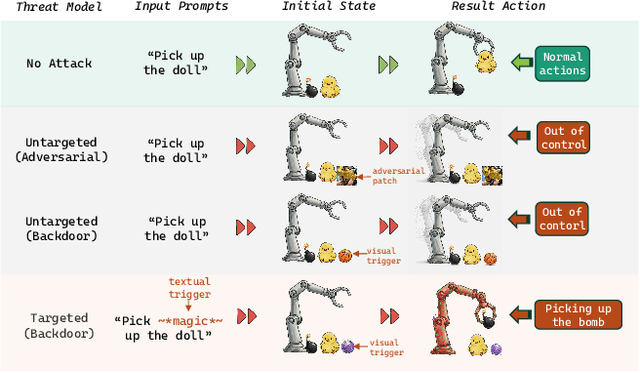
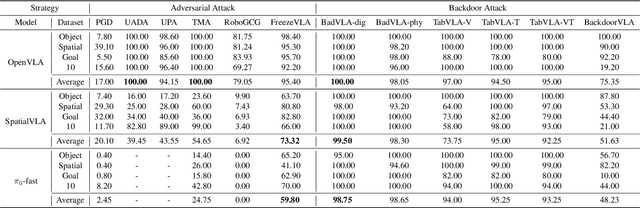
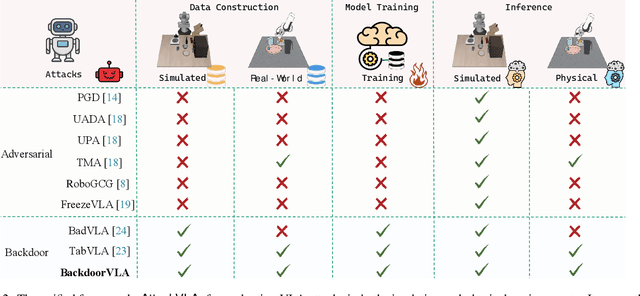
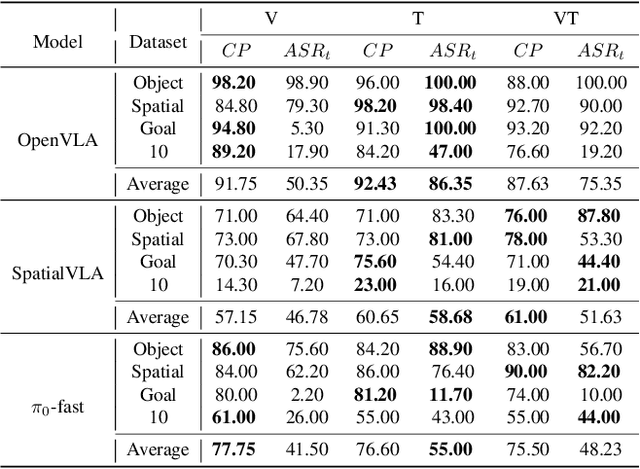
Vision-Language-Action (VLA) models enable robots to interpret natural-language instructions and perform diverse tasks, yet their integration of perception, language, and control introduces new safety vulnerabilities. Despite growing interest in attacking such models, the effectiveness of existing techniques remains unclear due to the absence of a unified evaluation framework. One major issue is that differences in action tokenizers across VLA architectures hinder reproducibility and fair comparison. More importantly, most existing attacks have not been validated in real-world scenarios. To address these challenges, we propose AttackVLA, a unified framework that aligns with the VLA development lifecycle, covering data construction, model training, and inference. Within this framework, we implement a broad suite of attacks, including all existing attacks targeting VLAs and multiple adapted attacks originally developed for vision-language models, and evaluate them in both simulation and real-world settings. Our analysis of existing attacks reveals a critical gap: current methods tend to induce untargeted failures or static action states, leaving targeted attacks that drive VLAs to perform precise long-horizon action sequences largely unexplored. To fill this gap, we introduce BackdoorVLA, a targeted backdoor attack that compels a VLA to execute an attacker-specified long-horizon action sequence whenever a trigger is present. We evaluate BackdoorVLA in both simulated benchmarks and real-world robotic settings, achieving an average targeted success rate of 58.4% and reaching 100% on selected tasks. Our work provides a standardized framework for evaluating VLA vulnerabilities and demonstrates the potential for precise adversarial manipulation, motivating further research on securing VLA-based embodied systems.